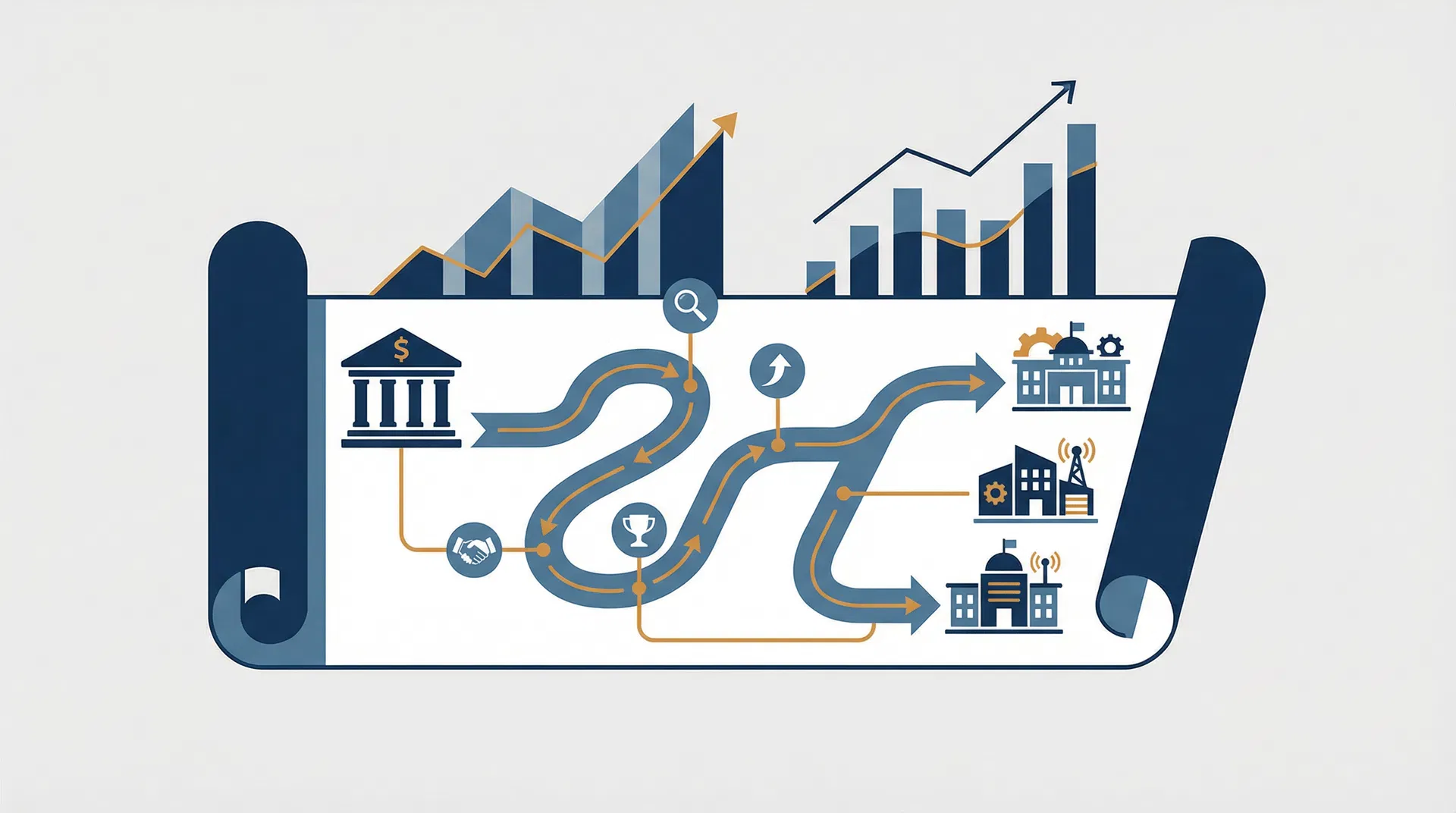
The U.S. government spends over $700 billion annually on contracts, making it the single largest buyer of goods and services in the world. Yet the lending infrastructure serving this market remains fragmented and underbuilt. For financial institutions looking to differentiate and grow, building a specialized GovCon lending practice represents a compelling strategic opportunity.
The Market Opportunity
Government contracting is not only massive — it's remarkably stable. Federal spending has grown consistently over decades, regardless of economic cycles. Defense spending alone exceeds $800B annually, and the broader federal procurement market continues to expand. More importantly, the contractors serving this market have a unique credit profile: their primary customer (the U.S. government) has a zero default rate on payment obligations.
Phase 1: Market Understanding
Before deploying capital, institutions need to build deep expertise in several areas. Understanding contract types is essential — firm-fixed-price, cost-plus, time-and-materials, and indefinite-delivery/indefinite-quantity contracts each have different risk profiles and financing needs. Knowing the regulatory landscape including FAR, DFARS, and agency-specific regulations is critical. And understanding the competitive dynamics of set-aside programs helps identify the most attractive borrower segments.
Phase 2: Product Design
GovCon lending products should be designed around the unique cash flow patterns of government contractors. Contract-backed lines of credit provide revolving facilities secured by awarded contracts. Mobilization loans offer short-term capital to fund the startup phase of new contracts. Progress payment financing bridges the gap between cost incurrence and government payment. And bid and proposal financing supports the business development costs of pursuing new contracts.
Phase 3: Origination Infrastructure
This is where most institutions struggle. Traditional origination methods (branch referrals, relationship managers) don't scale in the GovCon market. Modern GovCon lenders need data-driven lead generation that monitors contract awards in real-time, automated outreach capabilities that can engage contractors at the moment of need, and digital application and underwriting processes that match the speed of the market.
Phase 4: Risk Management
GovCon lending requires specialized risk management capabilities. Contract analysis tools should evaluate the terms, funding status, and performance requirements of each contract. Compliance monitoring must track DCAA status, SAM.gov registration, and set-aside certifications. And portfolio management should account for concentration risk by agency, contract type, and contractor size.
The Technology Imperative
Building a GovCon lending practice without modern technology infrastructure is like building a house without power tools — technically possible, but painfully slow and expensive. Platforms like Forwardflow provide the end-to-end infrastructure that makes a GovCon practice viable: from lead discovery and outreach (Connect), to risk assessment and compliance monitoring (Intelligence), to operational automation (Automate).
Getting Started
The most successful GovCon lending practices start small and focused. Pick a specific segment — perhaps 8(a) contractors in a particular NAICS code — and build deep expertise before expanding. Partner with organizations like the SBA, PTAC network, and industry associations to build credibility. And invest in the technology infrastructure that will allow you to scale efficiently as your practice grows.